
What Are the Options for Non-Surgical Scoliosis Treatment?
You have several options for non-surgical scoliosis treatment at Stem Cell Therapy NYC. When treatment with braces and physical therapy aren’t providing relief, stem cell therapy and PRP for spine conditions provide an effective way to treat scoliosis and many other conditions that cause back pain and neck pain.
Scoliosis is an abnormal curvature of the spine that often develops in childhood but may also develop in adolescence and adulthood. Scoliosis that starts at a young age may worsen over time and eventually cause problems such as back pain and breathing difficulties.
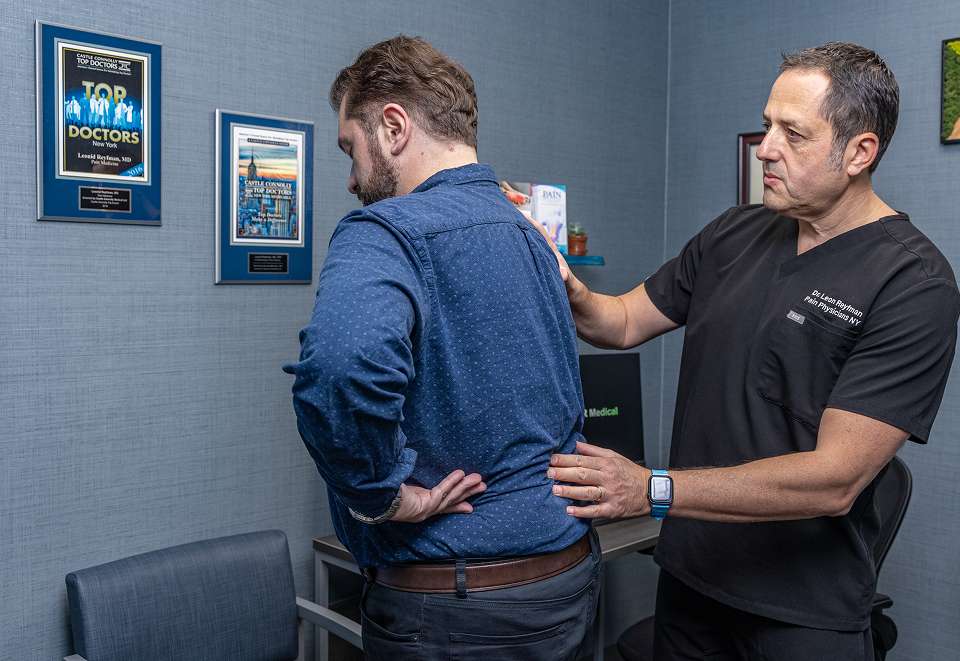
Dr. Leon Reyfman is a highly experienced pain management doctor in New York City who’s committed to finding non-surgical solutions with procedures that include:
- Stem cell therapy for your back
- PRP and stem cell therapy for nerves when scoliosis leads to pinched nerves in your back
- Stem cell therapy for joints and PRP for joints when referred pain creates a need for regenerative joint treatments
Are There Different Types of Scoliosis?
When you have scoliosis, there’s an abnormal side-to-side curve of the spine into the shape of a C or an S. This condition is usually separated into two main categories:
- Idiopathic scoliosis. This is the most common type of scoliosis. It develops in childhood or adolescence, and the cause of the spine curvature is unknown. It appears to run in families.
- Degenerative scoliosis.This type of scoliosis develops in adults when discs and joints weaken with age or disease. When one side of a disc degenerates more rapidly than the other, it causes the spine to tilt.
Adult scoliosis includes any scoliosis that’s diagnosed after the age of 18 when skeletal growth is complete. It ranges from mild to severe starting with a curve of 10 degrees or more in mild scoliosis to a curve of over 40 degrees in severe scoliosis.
Who Benefits from Non-Surgical Scoliosis Treatment?
Non-surgical scoliosis treatment using regenerative therapies benefits people who want to avoid surgery and haven’t gotten good results from traditional treatments for scoliosis such as medication, bracing and physical therapy. Factors that indicate you may be a good candidate for non-surgical scoliosis treatment include:
- Having mild to moderate curvature of the spine
- Looking for natural options for pain relief that are minimally invasive
- Experiencing stiffness, numbness or chronic back pain related to your spinal curvature
- Having difficulty standing up straight with leg numbness, weakness or pain
- Living with lower back pain
Advances in regenerative medicine provide new options for non-surgical treatment for scoliosis when a conservative approach to treatment doesn’t work. Regenerative therapies can’t correct the curvature of the spine but can stabilize and strengthen it while reducing your pain levels.
What Is Regenerative Therapy?
Regenerative therapy is an approach to treating pain that focuses on stimulating the body’s natural healing processes by repairing, strengthening and restoring tissues. The most common types of treatment include:
- Stem cell therapy procedures. Stem cells have the ability to differentiate into different cell types, such as cartilage, bone and nerve cells. Stem cell therapy for the back is done by using stem cells from your own bone marrow or fat tissue to relieve inflamed tissue and slow curve progression.
- Platelet-rich plasma therapy (PRP). Treatment with PRP uses your own platelets, which are a component of your blood, to deliver growth factors that reduce inflammation and accelerate the healing process.
- Prolotherapy. For this type of treatment, your doctor injects an irritant such as dextrose to jumpstart the body’s healing processes and reduce pain.
Stem cells and PRP are part of orthobiologics, which are treatments developed from natural substances that enhance the body’s ability to heal itself. For people with scoliosis living with chronic pain, regenerative spine treatments provide an innovative approach to non-surgical scoliosis treatment.
How Do Regenerative Therapies Relieve Symptoms of Scoliosis?
Regenerative therapies don’t straighten the spine, but they improve the health of spinal tissues and decrease pain related to spinal curvature. Some ways regenerative medicine techniques help with scoliosis include:
- Reducing inflammation. Inflammation is reduced in spinal muscles, ligaments and facet joints.
- Repairing degenerated discs.Stem cells repair discs that contribute to spinal imbalance.
- Strengthening tissues.Supporting tissues are strengthened to improve posture and alignment.
- Reducing pain.Pain that limits mobility and affects your quality of life is reduced.
Regenerative therapy as non-surgical treatment of scoliosis offers hope for people looking for an effective long-term solution for chronic pain without the risk of surgery. Reasons to choose regenerative therapy include:
- It’s a nonsurgical solution that has a much shorter recovery time than surgery.
- It reduces inflammation naturally.
- It’s an innovative treatment that regenerates tissues and cells.
- Your own cells are used, greatly reducing risks of complications or side effects.
When effective pain management is imperative to maintain your quality of life, regenerative therapy focuses on healing and strengthening rather than just controlling symptoms. Don’t keep living with chronic pain. Contact Stem Cell Therapy NYC today for non-surgical treatment of scoliosis or relief from other types of chronic pain.
Page Updated on Mar 23, 2026 by Stem Cell Therapy